


ABOUT
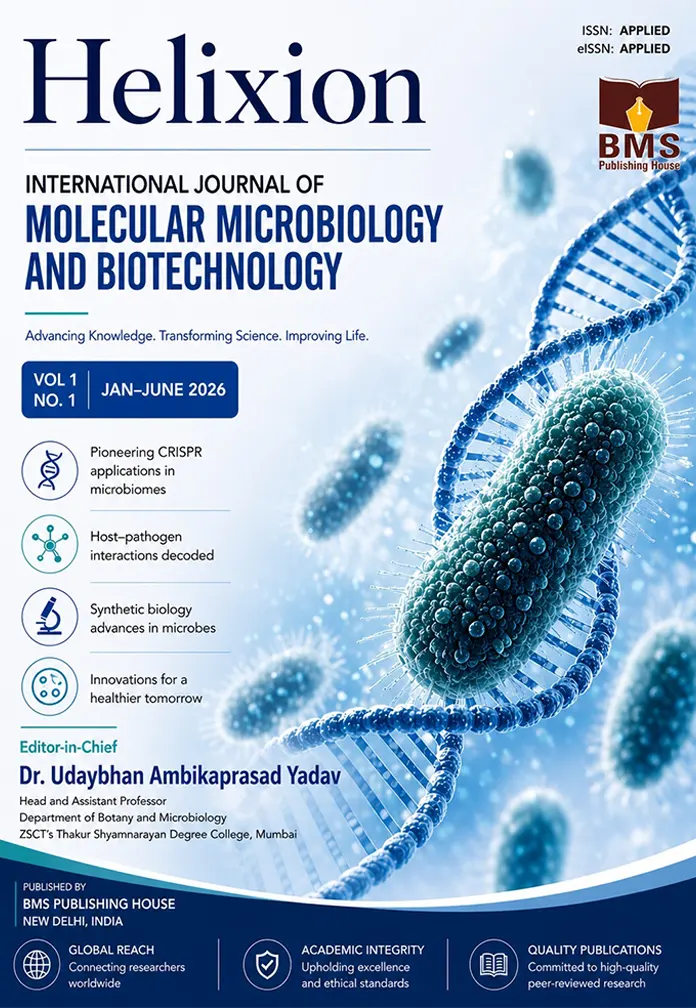
Helixion: International Journal of Molecular Microbiology and Biotechnology (HIJMMB)
Aim & Scope
Aim of the Journal
The primary Aim of HIJMMB is to provide a premier global platform for the rapid dissemination of cutting-edge, high-quality research in the fields of molecular microbiology and biotechnology. The journal seeks to bridge the critical gap between fundamental molecular research and practical, scalable biotechnological solutions that address pressing global challenges across healthcare, environmental management, and industrial sectors.
By offering an open-access, peer-reviewed forum, HIJMMB invites researchers, academicians, scientists, and industry professionals to submit original research articles, comprehensive reviews, and short communications that drive global innovation and shape the future of biological sciences.
Scope of the Journal
The scope of HIJMMB encompasses a broad range of theoretical, empirical, and applied research. The journal welcomes contributions across diverse thematic tracks, including but not limited to the following core areas:
1. Molecular Genetics & Genomics
⦁ Microbial gene expression, regulation networks, and operon dynamics.
⦁ Molecular mechanisms of CRISPR/Cas systems and genome editing tools.
⦁ Comparative genomics, metagenomics, and evolutionary microbial genetics.
⦁ Horizontal gene transfer, plasmid biology, and mobile genetic elements.
2. Pathogenesis & Host-Pathogen Interactions
⦁ Molecular and cellular mechanisms of microbial infection and colonization.
⦁ Identification, characterization, and regulation of microbial virulence factors.
⦁ Host immune responses, cellular defense mechanisms, and microbial immunology.
⦁ Molecular epidemiology and mechanisms underlying antimicrobial resistance (AMR).
3. Synthetic Biology & Metabolic Engineering
⦁ Design, construction, and optimization of novel microbial cell factories.
⦁ Metabolic pathway engineering and metabolic flux analysis for chemical production.
⦁ Development of whole-cell and molecular biosensors for diagnostic or environmental use.
⦁ Synthetic microbial consortia and artificial biological circuit engineering.
4. Environmental Biotechnology
⦁ Bioremediation of persistent organic pollutants, heavy metals, and industrial xenobiotics.
⦁ Microbial ecology, structural dynamics, and community responses in natural ecosystems.
⦁ The explicit role of microbes in climate change mitigation and carbon sequestration.
⦁ Waste-to-energy conversion, microbial fuel cells, and eco-friendly bioprocessing.
5. Industrial Microbiology
⦁ Advanced fermentation technology, kinetics, and bioreactor scale-up optimization.
⦁ Enzyme engineering, directed evolution, and immobilization for industrial biocatalysis.
⦁ Sustainable production architectures for biofuels, bio-based chemicals, and secondary metabolites.
⦁ Development and synthesis of biodegradable bioplastics (e.g., PHAs, PHBs).
6. Microbial Proteomics & Metabolomics
⦁ Large-scale, high-throughput analysis of microbial proteins, post-translational modifications, and proteomes.
⦁ Qualitative and quantitative metabolomics to understand complex cellular workflows.
⦁ Functional genomics and systems biology modeling of cellular processes.
⦁ Structural biology of microbial macromolecular complexes.
7. Applied Biotechnology
⦁ Translational innovations in agricultural biotechnology (biofertilizers, biopesticides, and rhizosphere engineering).
⦁ Food biotechnology, starter cultures, microbial fermentations, and probiotics.
⦁ Pharmaceutical biotechnology, including the development of novel biologics, therapeutic peptides, and vaccine candidates.
Types of Manuscripts Accepted
⦁ Original Research Articles: Full-length, innovative empirical studies introducing novel molecular insights or biotechnology applications.
⦁ Review Articles: Comprehensive, analytical syntheses of emerging trends and state-of-the-art developments in microbiology.
⦁ Short Communications: Rapid-turnaround papers highlighting high-priority breakthroughs or exceptional preliminary findings.
⦁ Case Studies & Technical Notes: Detailed field implementations of bioprocess systems or novel experimental methodologies/protocols.
⦁ Conference Proceedings: Peer-reviewed, high-quality thematic papers from international microbiology symposia.
EDITOR IN-CHIEF
| Name & Designation | Affiliation & Contact Details | Image |
|---|---|---|
| Dr. Udaybhan Ambikaprasad Yadav Head and Assistant Professor |
Department of Botany and Microbiology ZSCT’s Thakur Shyamnarayan Degree College, Mumbai Email: drudaybhan29@gmail.com Contact: +91 8097403858 |
 |
EDITORIAL BOARD MEMBERS
| Name & Designation | Affiliation & Contact Details | Image |
|---|---|---|
| Kunal Srinivash Thakur (Ph.D., M.Sc. B.Ed.) |
ZSCT’s Thakur Shyamnarayan Degree College Thakur Complex, Kandivali East, Mumbai Email: kunalsrthakur@gmail.com Contact: 8286889199 |
 |
| Dr. Prachi Sachchidanand Hatkar Senior Project Officer |
Advance Research Centre (ARC) for Ecology and Conservation Deccan Education Society, Pune University Maharashtra – 411004 Website: despu.edu.in Email: pprachi62@gmail.com |
|
| Dr. C. Azhakarraja HoD (i/c), Department of Commerce |
Bharat Ratna Dr. APJ Abdul Kalam Government Arts and Science College Rameswaram – 623526 Email: azhakarraja88@gmail.com Phone: 8870302803 |
|
| Dr. Yasodha T Professor & Head |
Department of Biotechnology Madha Engineering College Chennai – 600069, Tamil Nadu Email: btmbty@gmail.com Mobile: +91 8508797682 |
|
| Prof. Dr. Chee Kong Yap | Universiti Putra Malaysia ORCID: 0000-0003-0317-0999 Profile: View Profile Email: yapckong@hotmail.com |
|
| Wesam Al Khateeb (Ph.D.) Associate Professor |
Department of Biological Sciences Faculty of Science, Yarmouk University Irbid, Jordan Email: wesamyu@gmail.com Phone: +96227211111 |
|
| Pratham Robin Das MSc Food Science |
University College Cork, Ireland Email: Prathamdasstudy23@gmail.com Phone: 9136366482 |
|

Reviews
There are no reviews yet.